From PR Tool to AI Identity Infrastructure
Tags: AI, Product, Strategy
I built all of Real Big Deal. The entire product — front to back. And it worked. Really well, actually. But I never launched it.
That's the part of the story most people don't tell. When a product pivots, the narrative is usually clean: we tried X, learned Y, and evolved into Z. But the truth is messier. I had a finished product that I kept finding reasons not to ship. And for a while, I couldn't articulate why.
Now I can.
What I Built
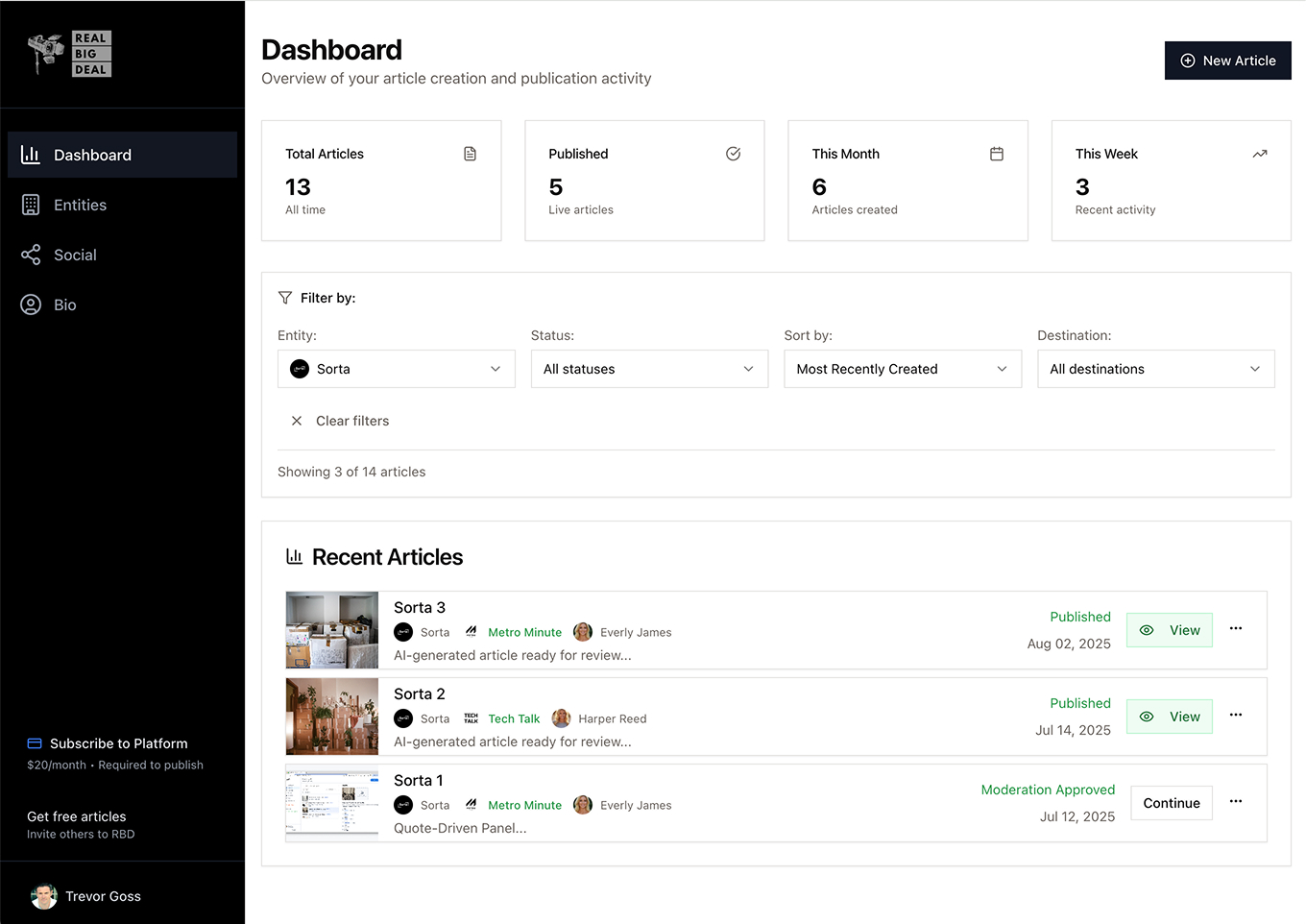
The original version of RBD was an AI-powered PR platform. The idea was to make media exposure accessible to startups and creators who couldn't afford expensive agencies. You'd submit your company details, and the system would generate polished press-ready articles in different formats — features, Q&As, founder profiles — then distribute them through a curated network of publishers.
I built some genuinely good features:
- Journalist Voice — AI that could write in a specific journalist's authentic style, trained on their past work. Not a generic voice, but their voice.
- Article Types — Structured frameworks that turn raw knowledge into publishable stories. Feature, Q&A, founder origin, product deep-dive.
- Social Share — One-click social content generated from published articles. Publish once, amplify everywhere.
- Entities — Structured company and people profiles that gave AI the context it needed to write accurately about a business.
The tech was compelling. All of it worked. The AI output was legitimately good. I was proud of what I'd built.
And yet I couldn't bring myself to launch it.
The Resistance I Couldn't Explain
For months, I had this low-grade resistance to the product I'd built. I kept telling myself it needed one more feature, one more round of polish. But that wasn't it. Something deeper was off, and I couldn't name it.
Then I noticed something about my own behavior.
I was getting almost all of my news from X and YouTube. Not blogs. Not news sites. Not the kind of publishers I'd built RBD to serve. I hadn't clicked through to a traditional publication in weeks. The content I consumed — and the content that shaped my understanding of the world — came from individuals on social platforms, not institutional publishers.
And it hit me: I'd built a really good solution to a world that barely existed anymore — and soon wouldn't at all.
A Solution for a Dying Workflow
The use case at the heart of original RBD was empowering legacy publishers. Helping brands get stories placed in traditional publications. Making the old PR workflow faster and cheaper with AI.
But the more I sat with it, the more it felt antiquated on arrival. I was building infrastructure to make a dying process more efficient. The publishers I'd be working with were part of an ecosystem I didn't even participate in as a consumer. I didn't read their content. I didn't think their model was the future. And the idea of spending years propping up that workflow felt wrong.
That's what the resistance was. It wasn't about the tech — the tech was great. It was about the workflow. I'd built a powerful engine and pointed it at the wrong thing.
The Aha
Once I saw it clearly, the next step was obvious. The most valuable thing I'd built wasn't the publishing pipeline — it was the structured context underneath it. The Entities feature. The company profiles. The relationship data. The machine-readable representation of who a company is and what it does.
That context layer was what made the AI output good. Without it, articles were generic. With it, they were specific, accurate, and genuinely useful. The difference was never the writing model or the prompts. It was the structured data feeding the system.
And here's the thing: that same structured context is exactly what AI systems need to understand, reference, and recommend a company. Not articles on legacy publisher sites. Not traditional PR placements. A machine-readable identity.
The Internet Is Changing
For most of the internet's history, companies built websites for people. Homepages, landing pages, blog posts — all written for human readers navigating through search results or social links.
That model is breaking down. The internet isn't just read by humans anymore — it's interpreted by machines. Large language models, AI search engines, and intelligent agents parse, summarize, and explain the world's information on behalf of users. Instead of clicking through ten links, people ask an AI system a question and get a synthesized answer.
That answer is built from context. The companies that AI systems can understand show up in those answers. The companies they can't interpret disappear from the conversation entirely.
Marketing, distribution, and content all work differently in an AI-native world. Traditional PR produces articles that sit on a webpage and slowly decay. What matters now is structured context that feeds the entire ecosystem — content, social, search, and AI discovery flowing from the same source of truth.
What RBD Became
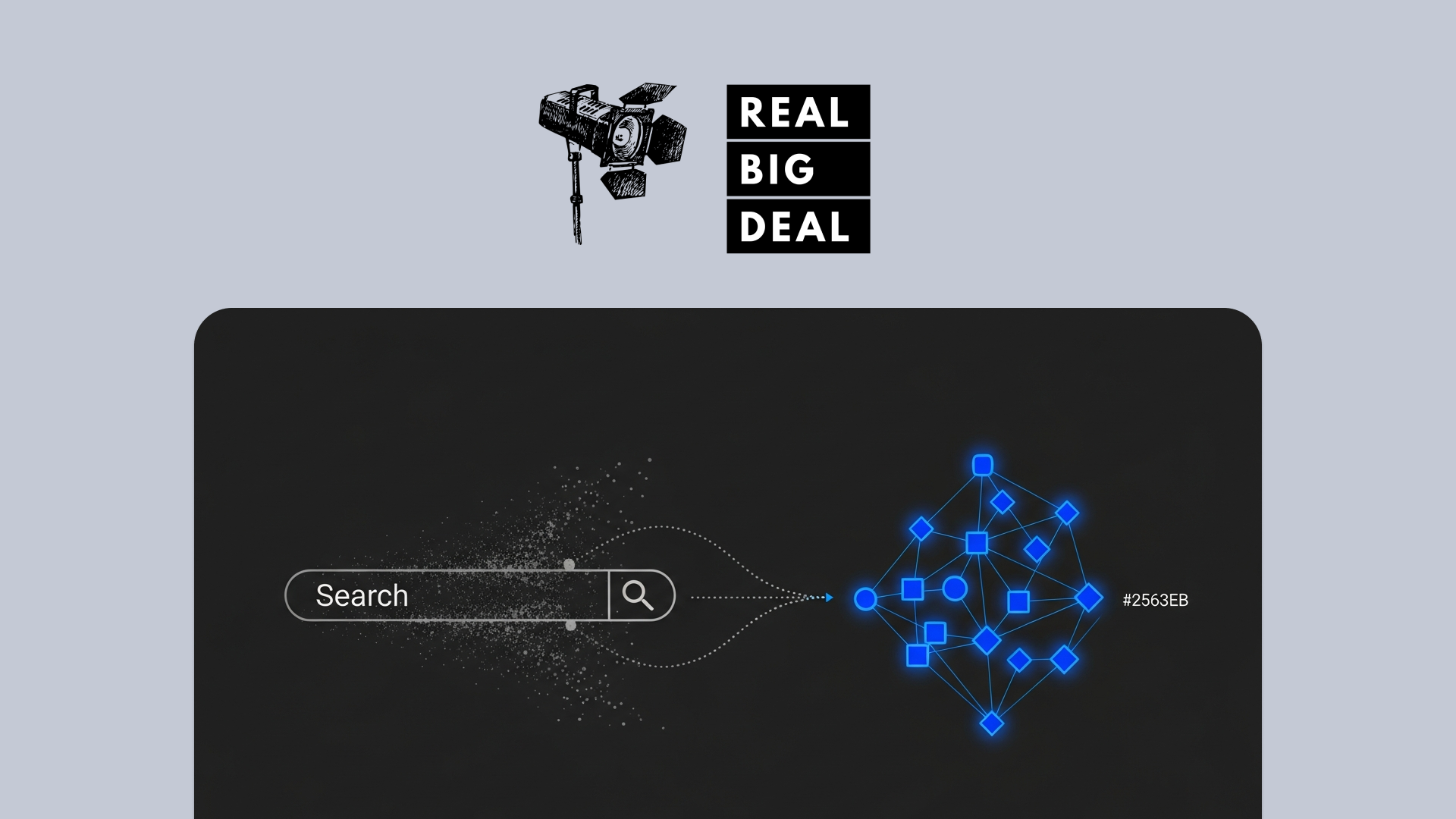
Real Big Deal is now AI-era identity infrastructure. Instead of helping brands place stories in traditional publications, it creates the machine-readable version of a company — structured context that AI systems can understand, reference, and recommend.
The system works in layers:
- People + Entities: Founders, executives, and experts each have their own profile. Companies, products, and initiatives connect to them, forming a network of context that machines can traverse.
- Context Layer: Those profiles feed a shared context layer that powers all content and AI discovery. Structured data, consistent narrative, machine-readable relationships.
- Content Engine: Articles, social posts, and publications are generated from that context — not from scratch. Every piece reinforces the company's identity.
- AI Discovery: When the context graph exists clearly, AI systems can confidently describe a company. And when AI can describe a company, it can recommend it.
The original features — Journalist Voice, Article Types, Social Share — still exist and still work. They're just powered by something deeper now. And instead of serving a dying workflow, they're part of a new paradigm for how companies establish identity in an AI-native world.
The Lesson
Sometimes resistance is information. I spent months thinking something was wrong with me for not wanting to launch a product I'd built and was proud of. Turns out, the resistance was the most honest signal I had. The tech was right, but the direction was wrong.
I could have powered a dying process. Instead, I'm powering a new paradigm — with much of the same technology, just packaged differently. The engine didn't change. Where it's pointed did.
In the age of AI, visibility is reputation. If a company isn't being surfaced when someone asks "Who's the best in this space?" — it might as well not exist. RBD builds the foundation that makes sure you do.